"As our visual language evolves, the playing field is levelling. Graphic designers, sculptors, painters, creative developers, and even musicians amorphously meander across different parts of our creative industries. As a consequence, I often wonder what the term 'Illustration' now means. Maybe as a medium it might need to do more than vocationalise aesthetics and cultivate a border palate of profundity for its own survival." -Michael Salu
Traditionally, illustration is thought of as the profession of producing art to accompany text in the context of books, usually drawn or painted. Although this is correct and often the case, it constitutes only a part of what the field entails, the boundaries for which are seemingly constantly changing. Illustration as a word is derived from the term 'enlighten', or to cast light upon, and reflects the role of imagery that comes under the term to compliment and enhance the content of the text it accompanies- the term does not specify or limit the media or format in which this purpose is served, and so I would argue that illustration is really just an umbrella term which encompasses the works of the above mentioned graphic designers, sculptors and painters...etc, despite what is usually assumed. It is the purpose that defines illustration, not the form of aesthetic. Therefore, while the purpose of illustration isn't changing, the number of possibilities for its application IS. This is a result of rapidly advancing technology, opening up possibilities like moving and/or interactive illustrations for apps or digital articles for example. Illustration has often been a platform for the delivery of social and political commentary in addition to more commercial applications, often by the artist themselves- this idea of having a 'voice' is also a key aspect that remains unchanged (if not potentially enhanced) by the recent developments.
In terms of my own work, I have been increasingly interested in working with photography, as I believe that is where my strengths reside. I'm currently looking to incorporate it into my illustration work, while also continuing them both separately in their more conventional forms along side each-other. There's a whole spectrum of ways in which photography can be brought into the field of illustration, meaning lots of room for experimentation. I also believe that works of both conceptual value and pure aesthetics have their place within illustration.
I don't believe that there's any call for replacing the term 'illustration', as it still means the same as it always has- it's the general understanding of its meaning that needs to be changed, or 'enlightened'. I believe the reason for its validity as a term being recently questioned purely stems from the natural and logical adaptation to accommodate for new technology- something that has made obvious the pre-existing span of specialisations that can and have contributed to the discipline. In my opinion, a little less focus on definitions, divisions and genres in general removes a lot of restraints inadvertently placed on creatives by others and themselves. Hybridity, versatility and transcendence of boundaries is surely only a good thing.
Wednesday, 11 December 2013

Self-Directed Project 2 - Fleurs du Mal
After deciding against my initial project idea, I chose instead to create work based on / inspired by the poetry of the French 19th Century writer, Charles Baudelaire. Specifically, I focused on the collection entitled Les Fleurs du Mal (The Flowers of Evil). The predominant themes of the poems were Sex and Death, which made them highly controversial at the time of release- some were even banned from publication for some time, as a result of 'creating an offence against public morals'. The poems are often complex even in their own language, and it is sometimes necessary to read multiple translations of one text to grasp the meaning behind it, though their emphasis on sense of atmosphere and feeling are interesting and challenging to work with. Wikipedia summarises the works succinctly in describing how 'He also touched upon lesbianism, sacred and profane love, metamorphosis, melancholy, the corruption of the city, lost innocence, the oppressiveness of living, and wine. Notable in some poems is Baudelaire's use of imagery of the sense of smell and of fragrances, which is used to evoke feelings of nostalgia and past intimacy.'
I began by reading through the poems, the themes referred to above becoming apparent from the start. A common visual referred to throughout the works is the heart- the word appears over 50 times in the collection. I decided to use watercolour paints, as colour is integral to the nature of the source material. The following show the first piece in progress:


I began by reading through the poems, the themes referred to above becoming apparent from the start. A common visual referred to throughout the works is the heart- the word appears over 50 times in the collection. I decided to use watercolour paints, as colour is integral to the nature of the source material. The following show the first piece in progress:


After completion, I decided to incorporate a visual representation of the perfumes and scents frequently described by Baudelaire.

The watercolours lent themselves well to the effect, though after some feedback I decided to work over the initial cloudy plumes to look more like the desired result, something that in reality of course cannot be seen, but is often depicted in a recognisable way.

The faded colours of the perfume are intended to evoke the sense of nostalgia conjured in the writing, the colours also inspired by the shades you might see in dying flowers.
Sunday, 8 December 2013
Self-Directed Project 2
For the project that would lead up until Christmas, I chose to do the third option for the second self-directed project, which allowed the freedom of choosing a theme to work with, on the basis that the subject would have depth and the potential to be well-researched. After deliberating on a couple of different ideas, I initially decided to base my work on a collection of old news extracts (spanning over 200 years) that I had come across from where I used to live, given to me by a neighbour. They had been collated from old papers and locally archived documents, type-written up and chronologically ordered in a book. Here are some examples I particularly liked after reading through:


I found the quirky nature of some of the stories interesting and potentially good for illustrating. I began some brief concepts relating to the above supernatural-related extracts while trying to work out how to approach the stories in terms of media, format, development...etc. None of my ideas seemed to have the potential to be substantial with the source material I had to work with, as I decided that I would need a focus, requiring a decent number of similar extracts to illustrate and yield a cohesive collection. After looking, there was unfortunately little else in a similar vein to the snippets I had hoped to draw upon. After some time, I eventually decided to change my project theme for something I found more possibilities in, with room for experimentation. The following are some of my initial results working with the 'Mad dogs' idea, before I switched project themes.


I still feel the idea of illustrating some of these stories has potential, and is something I may revisit in my own time with less factors to restrict it.

Monday, 2 December 2013
Dwelle Lecture
Last Tuesday, Ric Frankland (Director of Dwelle) presented a lecture on his company, speaking about its ideas, aims and achievements so far. He introduced himself as an Architect and Eco-building Manager, and proceeded to share with us his story of how his company came to be as it is today. and what preceded that. He has previously worked as a lecturer at Universities, teaching the subjects of Architecture and Interior Design. His company specialises in the design of small, ecologically-friendly and sustainable housing. The unique design around which all of Dwelle's range are based came about as a modification of an entry to an architectural concept design competition Ric had entered. The design is innovative in it's layout, selected materials, adaptability, affordability and ease of construction. Ric emphasised his enthusiasm for the use of environmentally friendly and sustainable building materials, particularly wood, which his concepts are predominantly composed of. The buildings are prefabricated, with the original award-winning design being modifiable to accommodate a whole spectrum of potential purposes. At 'first glance', the presentation had no obvious or direct relevance to illustrators, though it soon became apparent that Ric's experiences and attitudes to his passion can be applied to any creative field. He made a point of underlining the power of perseverance and experimentation, and shared the following quote: "Making a different mistake every day is not only acceptable, it is the definition of progress." -Robert Brault. He also talked about the power of networking, as well as the effectiveness of word-of-mouth recommendation. What interested me personally the most about his presentation, was his openness about his hesitance to define exactly what he does or intends to do- he spoke of how he may well be working on very different projects later down the line, and that despite identifying as an architect, he's less interested in the actual production side of his designs. I relate to this in that I'm currently open to whatever possibilities may arise, and I'm not yet sure which direction my work (photography and illustration) is taking me. My aim is to continue to experiment and remain versatile, and Ric validated this approach.
Sunday, 1 December 2013
Hopes, Fears and Opportunities
During a group discussion on the subject of 'Hopes, Fears and Opportunities' earlier on in the year, we shared and talked through our different thoughts and concerns on the matter, and how best to address them. My main 'fears' I identified regarding the course and my career in the creative industry in general included: Producing work that isn't of a commercial-friendly / marketable nature, not having a consistent style or visual identity, and taking on the impending 8000 word dissertation (while also maintaining my standard of work during the most hectic period). The first of the two issues were raised by others also, being fairly common concerns for students- especially at this stage of the course.
On the subject of marketable work, it was suggested and agreed that despite the concern, it's not wise to attempt to change what you're producing in order to second-guess a target audience whose interests are likely constantly changing (what's currently fashionable...etc), and that the best approach is retain creative integrity and work with what interests you- the logic being that if you're passionate about what you're doing, then other people will be likely to have an interest in your work also. Therefore, you don't necessarily have to 'sell-out' and sacrifice personal interests and creative preferences to make money. The aim I derived from this was simply to continue working on subjects that interest me, which I have done through the selection of 'Authorstrator' projects.
In regards to the concern over consistency of style, the advice offered has been to not worry over this, as it is something that develops organically and not always a result you can always successfully consciously create. Though I still feel a more distinctive, consistent aesthetic in my work would be beneficial, I have been experimenting with different media over this last semester with the intention of maintaining versatility, or at least learning what areas I'm proficient in. As I have no defined goal in terms of what aspect of the creative industry I would like to work, I feel this approach is logical in that respect.
My third, more specific concern surrounded the context dissertation which at the time of the discussions was yet to come. Although I am confidant in my writing ability, I have previously found essays to be stressful at times when working on them alongside my other work. As of now, I am more than half-way through my dissertation, having received encouraging feedback so far. I have greatly improved upon my own productivity rate with my writing, having adopted a different approach to preliminary research and organisation, which has helped me vastly. The rest of the dissertation will no-doubt continue to be a challenge, especially balancing my time between it and my other project, but I'm pleased with my progress so far.
In terms of the next semester (in which I shall be beginning my final major project), my aim is to once again draw upon my interests and bring them into the work in some way, hopefully in a manner that represents well all that I have explored so far in terms of both technique and subject matter. I also aim to have my dissertation comfortably completed before the final deadline in January, in order to avoid further stress and ensure that nothing is rushed.
Natural World - 'Mutation' (Continued)
To further develop the theme, I was advised to experiment with placing my subjects within some form of environment or context, rather than solely isolated in negative space as I generally tend to do. I decided to revert back to the surrealist theme as with my first painting for the project. Like with the initial work, I simultaneously produced both traditional and digital pieces in order to explore different ideas. The following are examples of the former:


The resulting aesthetic wasn't as subtle as it could be with practise, but I believe they were at least successful in terms of arrangement.

I felt the six paintings in this arrangement complimented each other well in addition to being eye-catching and vivid. Though the images aren't in a sequence, I feel this format of display works well for them.

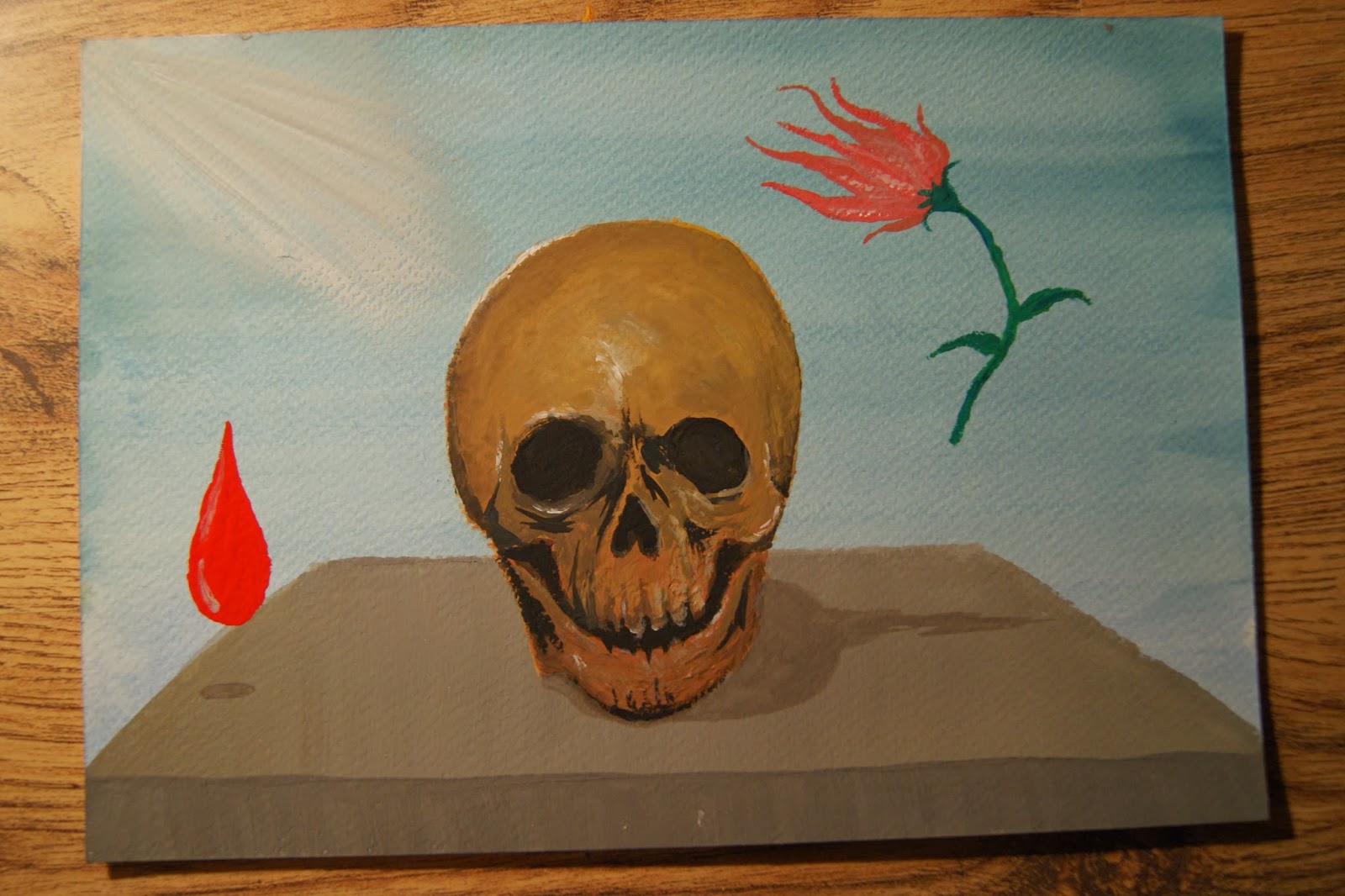

I painted these using watercolours for backgrounds, and gouache paints for the rest. The process of painting in this manner was relatively unfamiliar, but I tried to experiment with different colour palettes, taking advantage of the freedom of surrealism. Each piece was relatively spontaneous and randomly arranged, with elements added as I thought of them. I drew inspiration from various sources, such as aesthetically from surrealist works including those of Dali:

The Face of War, Salvador Dali
And also compositionally and thematically from 16th and 17th Century 'Vanitas' paintings:

Still-Life with a Skull, Philippe de Champaigne
...
The following are a couple of examples of digital compositions I experimentally arranged from various separate drawn and painted elements:


...
Finally, for the end of the project, a mock-exhibition of work was staged. We were free to plan and assemble the display in whatever configuration we chose within individually designated spaces. This was my arrangement:

Monday, 16 September 2013
Natural World - 'Mutation'
For the first project of third year, I decided to approach the brief from an 'authorstrator' standpoint, selecting the theme entitled 'The Natural World'. Amongst the keywords relating to the Darwin-inspired source were 'evolution' and 'mutation', which I chose to use as my starting points. An example of mutation in nature that interests me is the infection of insects and arachnids by the Cordyceps fungi:
Inspired by this, I painted this piece using gouache. I was interested in the idea of this fungi affecting not only insects, but humans too:

I was pleased with the result of this piece considering my inexperience with painting, though I decided not to continue producing more, because I didn't want to keep portraying people. I changed my media choice to pencil drawing, and decided instead to focus on skulls: still a human subject, yet more visually interesting to study. I decided to produce a series of drawings of skulls, each with a different form of mutation or abnormality. I liked the idea of leaving it to the imagination of the viewer as to how the living subject may have looked, and their story... The following are some examples.


I produced eighteen drawings in total, before beginning to introduce my images into contexts rather than just negative space. One means by which I did this was to combine these drawings with photos of mine, all being examples of urban decay that were taken in abandoned hospitals. The two themes of urban and natural decay work together interestingly, sharing similar processes, like the gradual reduction to 'bare-bones' internal structure. Furthermore, the growth that occurs in urban decay is almost a form of mutation, with the unpredictable transformations that happen as a result of nature reclaiming. With these pieces, I tried to echo the nuances of the urban decay with my drawings in how they were incorporated.


Subscribe to:
Posts (Atom)